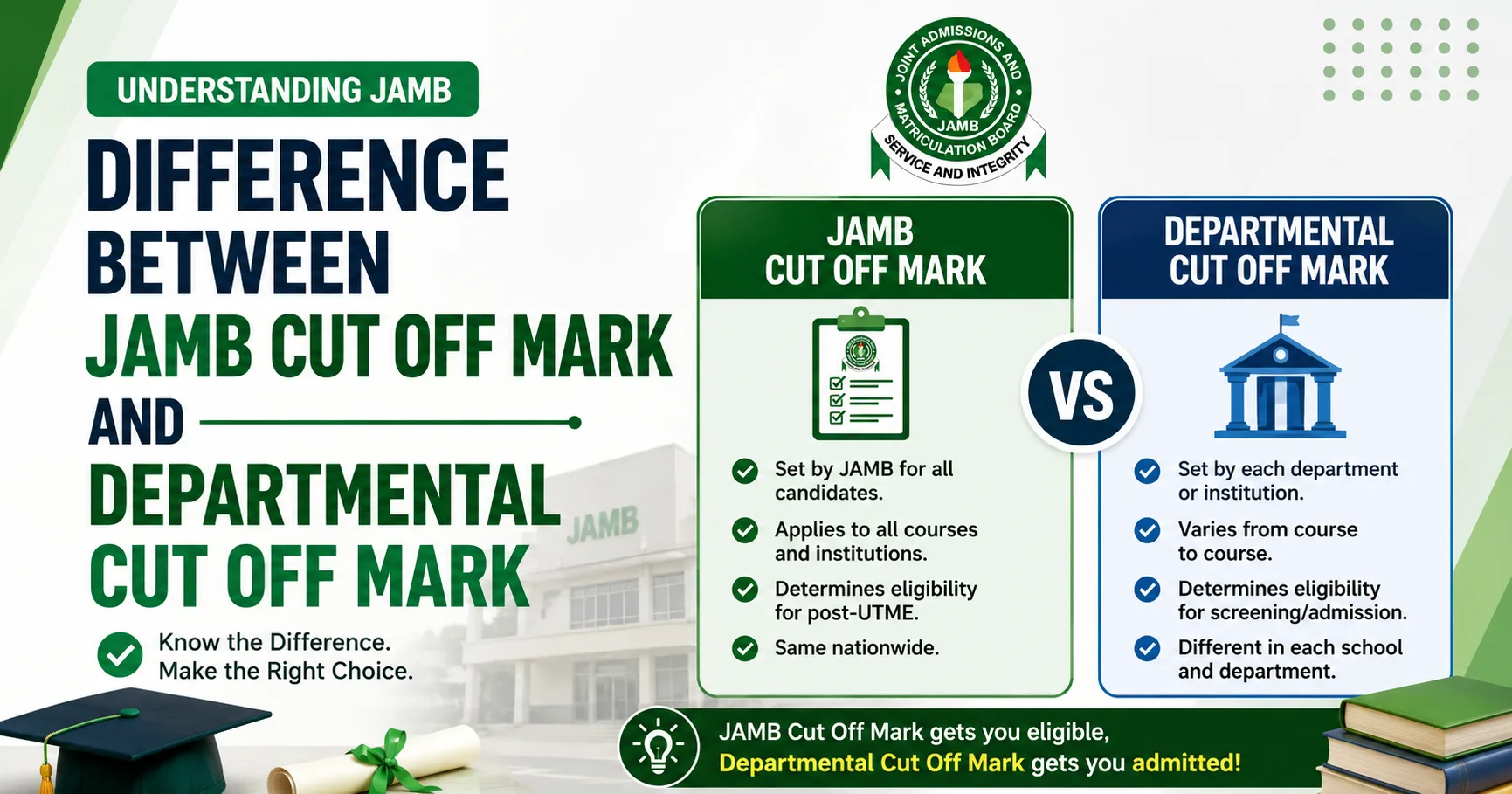
The difference between JAMB cut off mark and departmental cut off mark is one of the most misunderstood topics among Nigerian students preparing for university admission. Every year, thousands of candidates score above the JAMB national benchmark, only to be shocked when they fail to secure admission into their chosen department.
This confusion usually happens because many students do not understand that these two cut off marks are not the same thing, and that meeting one does not automatically guarantee the other.
In this article, we will break down the difference between JAMB cut off mark and departmental cut off mark in simple terms, using real examples and updated figures for the 2026/2027 admission session, so you can plan your admission journey with confidence.
What Is the JAMB Cut Off Mark?
The JAMB cut off mark is the minimum score approved by the Joint Admissions and Matriculation Board during its annual Policy Meeting on Admissions. This score serves as the general entry requirement that every candidate must meet before their result can even be considered for university admission in Nigeria.
For the 2026/2027 academic session, JAMB approved 150 as the national minimum cut off mark for universities, 150 for Colleges of Nursing, and 100 for polytechnics. This means that any candidate who scores below 150 in the UTME cannot proceed to the next stage of university admission, regardless of how brilliant their chosen course may be.
It is important to note that the JAMB cut off mark is only a starting point. Individual universities are allowed to set their own institutional cut off marks above this national benchmark, depending on their popularity and the number of applicants they receive.
What Is a Departmental Cut Off Mark?
A departmental cut off mark is the minimum score set by a specific faculty or department within a university for candidates seeking admission into a particular course. Unlike the JAMB cut off mark, which applies broadly across an institution, the departmental cut off mark is course specific and can vary widely even within the same university.
For example, a university may have an institutional cut off mark of 200, but its Department of Medicine and Surgery may require a much higher score, while a less competitive course like Library Science may accept candidates closer to the general institutional benchmark.
This is one of the clearest ways to explain the difference between JAMB cut off mark and departmental cut off mark to students who are still confused about the admission process.
Difference Between JAMB Cut Off Mark and Departmental Cut Off Mark
To fully understand the difference between JAMB cut off mark and departmental cut off mark, the table below breaks down the key distinctions.
| Feature | JAMB Cut Off Mark | Departmental Cut Off Mark |
|---|---|---|
| Set by | JAMB, during the national Policy Meeting | Individual university faculties or departments |
| Coverage | Applies nationally to all candidates | Applies only to a specific course within a school |
| Purpose | General eligibility for admission consideration | Determines eligibility for a specific course |
| Flexibility | Fixed for a particular admission session | Can change yearly based on competition for the course |
| 2026/2027 example | 150 for universities, 100 for polytechnics | Varies by course, often 180 to 260 or higher |
| Who it affects | Every UTME candidate nationwide | Only candidates applying for that specific course |
This table shows clearly that the difference between JAMB cut off mark and departmental cut off mark comes down to scope and purpose. One is a general gateway, while the other is course specific screening.
2026/2027 JAMB National and Institutional Cut Off Marks
Before we go further into departmental requirements, it helps to understand the institutional cut off marks that some popular universities have adopted for the 2026/2027 session.
These figures were announced during the 2026 JAMB Policy Meeting held in Abuja.
| Institution | Approved Cut Off Mark (2026/2027) |
|---|---|
| Pan-Atlantic University | 220 |
| University of Lagos (UNILAG) | 200 |
| University of Ibadan (UI) | 200 |
| Obafemi Awolowo University (OAU) | 200 |
| University of Benin (UNIBEN) | 200 |
| University of Nigeria (UNN) | 200 |
| Covenant University | 200 |
| Lagos State University (LASU) | 195 |
| Ahmadu Bello University (ABU) | 180 |
| University of Abuja (UNIABUJA) | 180 |
| University of Ilorin (UNILORIN) | 180 |
| Bayero University Kano (BUK) | 160 |
| Nnamdi Azikiwe University (UNIZIK) | 160 |
| Osun State University | 160 |
| National minimum for all other universities | 150 |
| Polytechnics nationwide | 100 |
These figures represent institutional cut off marks, not departmental ones. A candidate can meet a university’s institutional benchmark and still fall short of the departmental cut off mark for their preferred course, which brings us back to the core difference between JAMB cut off mark and departmental cut off mark.
Sample Departmental Cut Off Marks for Popular Courses
Since departmental cut off marks are set by individual faculties, they differ from one course to another and one school to another.
The table below gives a general idea of how competitive courses typically demand higher scores than the university’s institutional benchmark.
| Course | Typical Departmental Cut Off Range |
|---|---|
| Medicine and Surgery | 250 to 300 |
| Pharmacy | 230 to 270 |
| Law | 220 to 260 |
| Engineering (all fields) | 200 to 250 |
| Computer Science | 200 to 240 |
| Accounting | 190 to 220 |
| Mass Communication | 190 to 220 |
| Nursing Science | 200 to 240 |
| Economics | 190 to 210 |
| Education courses | 150 to 190 |
| Agriculture related courses | 150 to 180 |
| Arts and Humanities courses | 150 to 180 |
These ranges are only guides. Every student should confirm the exact departmental cut off mark from their chosen university’s admission portal, since figures change yearly based on the number of applicants and available spaces.
Why the Difference Between JAMB Cut Off Mark and Departmental Cut Off Mark Matters
Understanding the difference between JAMB cut off mark and departmental cut off mark is not just academic knowledge. It has real consequences for your admission chances. Here is why it matters.
- It prevents false hope: A candidate who scores 180 may celebrate meeting the national cut off mark, without realising that their desired course requires 220 or more at their chosen school.
- It helps with course selection: Knowing the difference between JAMB cut off mark and departmental cut off mark allows students to choose courses that match their actual scores, rather than aiming for departments that are statistically out of reach.
- It guides post UTME preparation: Many departments use post UTME screening scores alongside UTME results to determine final admission. Knowing the departmental cut off mark helps you prepare adequately for this stage.
- It supports better decision making: Some students discover, too late, that changing their course of study earlier could have improved their admission chances. Understanding both cut off marks early gives you room to make smarter choices.
How to Check Your Departmental Cut Off Mark 2026/2027
Since departmental cut off marks are not fixed nationally, here are practical steps to find the correct figure for your course of interest.
- Visit the official admission or JAMB portal of your chosen university.
- Search for the specific faculty or department handling your course.
- Check the university’s previous admission list, since many schools publish the scores of admitted students from past sessions.
- Contact the admission office directly if the information is not published online.
- Compare the departmental figure with your UTME score before applying for post UTME screening.
Skipping this step is one of the biggest reasons students misunderstand the difference between JAMB cut off mark and departmental cut off mark, and end up applying for courses they do not qualify for.
Common Mistakes Students Make that You Must Not Make Too
Many Nigerian students confuse these two cut off marks because of a few recurring mistakes.
- Assuming that meeting the JAMB national cut off mark automatically qualifies them for any course.
- Ignoring the department’s historical admission data before applying.
- Choosing highly competitive courses like Medicine or Law without checking the departmental requirement first.
- Relying on outdated cut off mark information from previous admission sessions.
- Failing to confirm figures directly from the school’s official source before registering for post UTME.
Avoiding these mistakes starts with a clear understanding of the difference between JAMB cut off mark and departmental cut off mark discussed throughout this article.
Frequently Asked Questions
Is the JAMB cut off mark the same for all universities?
No. JAMB sets a national minimum, but universities can set their own institutional cut off marks above this figure, as shown in the table earlier in this article.
Can I meet the JAMB cut off mark but still be rejected by a department?
Yes. This is the most common outcome of not understanding the difference between JAMB cut off mark and departmental cut off mark. Departments set their own requirements that may be higher than both the national and institutional benchmarks.
Do departmental cut off marks change every year?
Yes. They depend on factors like the number of applicants, available admission slots, and overall performance trends for that admission session.
Where can I find accurate departmental cut off marks?
The most reliable source is the official website or admission portal of the specific university you are applying to.
Conclusion
The difference between JAMB cut off mark and departmental cut off mark can determine whether your admission dream becomes reality or turns into disappointment. The JAMB cut off mark only opens the first door, while the departmental cut off mark determines whether you can actually walk into your chosen course.
By understanding both figures clearly, checking updated tables, and confirming departmental requirements directly from your school, you give yourself a much stronger chance of securing admission in the 2026/2027 academic session.
Before you proceed with your application, take time to explore our other detailed articles on JAMB cut off marks for specific courses, institutional cut off marks for top universities, and post UTME screening requirements. These related guides will give you a complete picture of what it takes to gain admission into your dream course this year.

An education writer with almost a decade of experience helping Nigerian students prepare for JAMB and Admission. Hauwa is passionate about ensuring that students have the resources and guides they need to succeed in their academic journey.